Woman working at Terre di Cannabis farm. Photo by Terre di Cannabis on Unsplash.
Oakton Community College is offering a cannabis certification course beginning with their fall semester. The course, Cannabis Dispensary and Patient Care Specialist Certificate is geared towards the rapidly evolving cannabis market in Illinois.
“We saw an opportunity to provide job training for students in an emerging market,” said Bob Sompolski, Dean of STEM & Health Careers. Sompolski continued, “Starting in January the law will allow recreational marijuana to be sold. We are having internal discussions on how to expand this curriculum to try and address that market.”
Ruth Williams, Assistant VP of Academic Affairs, said “This fall we launched the program. We currently have 100 students enrolled in the program. And we have over 400 students that are on our inquiry or waitlist for the program. So, we’re looking to expand the program this spring.”
Oakton – located in Des Plaines, a suburb of Chicago, also hosted the Cannabis Business Alliance of Illinois Career Fair. There were several vendors present offering jobs for dispensaries, cultivations, and transportations. There were also organizations to help people looking to get into the cannabis industry business.
Cannabis plant farm. Photo by Matteo Paganelli on Unsplash.
In 2013, the Obama administration signed the Cole Memorandum, which formed a federally protected shelter for marijuana companies to operate by employing a hands-off approach of non-prosecution against cannabis businesses and users who comply with state laws. However, in January 2018, Donald Trump appointed former attorney general Jeff Sessions revoked the Cole Memo, generating an atmosphere of skepticism, especially among financial institutions.
Nevertheless, hope lingers for the cannabis industry. In September 2019, the House overwhelmingly voted 321 to 103 and passed The SAFE (Secure and Fair Enforcement) Banking Act. This law seeks to grant protections to financial institutions that work with state-licensed cannabis companies, extending them the same safeguards afforded other businesses.
But, the House passing The SAFE Banking Act is only half the battle. The real uphill battle is with the Republican-majority Senate. In the past, the GOP had a more negative outlook on marijuana than the Democratic or Independent party. And, Senate Majority Leader Mitch McConnell has been known to block bills regarding cannabis.
In able for this bill to become a law, it has to be voted on and passed by the Senate then the President has to sign the bill into law or he can veto it. If it is vetoed, it is sent back to the House and it starts all over again. The process can be very long.
While The SAFE Banking Act awaits for its faith in Washington, D.C., businesses like Sheepscot General of Whitefield, Maine continue to struggle to attain access to bank services.
Sheepscot General grows organic hemp which technically is legal under the 2018 Farm Bill that legalized hemp at the federal level. This bill revised the Controlled Substances Act to clear hemp from the definition of marijuana. Hemp contains less than 0.3% or less THC content (by dry weight). So, while it isn’t entirely lacking psychoactive compounds, it will not get you high.
The Sheepscot General organic hemp farm and yellow truck. Photo provided by Taryn Marcus.
Recently, Sheepscot General owners Ben and Taryn Marcus informed me that their bank terminated their bank and loan accounts. So, why did this happen?
According to the bank’s correspondence with Ben and Taryn, “there are lengthy and burdensome requirements for federally chartered banks to be sure the product meets federal regulations for financing. The Farm Bill changes mean it might become less difficult for banks to work with hemp-related customers from an operational and compliance standpoint. But neither the Financial Crimes Enforcement Network (FinCEN) nor federal bank regulators have issued updated guidance on working with hemp businesses following this change.”
The communication also mentioned, “We are waiting on the hemp amendments in the SAFE Banking Act, which passed 321-103 and now heads to the Senate, which instruct federal banking regulators to issue guidance to financial institutions confirming the legality of hemp and hemp-derived CBD products within 90 days of the enactment of the law.
We understand the impact to our customers, thus we are actively working on a solution to serve our local hemp farmers, but at this time, we do not have the process in place to also meet federal regulations. We look forward to more clarity and direction from our regulatory agencies as this is a complex and evolving situation, and we hope to serve local hemp farmers soon.”
In my opinion, therein lies the problem. Hemp is being used in CBD products and production of these products is in boom. CBD is associated with cannabis which is still a Schedule I drug under CSA. Main is also one of the states the legalized marijuana for recreational and consumption use. At the end of the day, banks are still banks and financial constitutions are conservative by nature.
The 2018 Farm Bill became law in December 2018. Here we are in the last quarter of 2019 and still, banks have not received guidance from the government on how to proceed to work with hemp businesses.
I asked Taryn how this will affect their business’ operation, she said “We are struggling to find another bank that will work with us that is in reasonable distance since we do cash deposits more than once a week because of our farm store. We may have to hobble something together that will take more time and energy than the set up we have now. Luckily we have a great network and we have been quickly connected to people that are helping us put a plan together hopefully this will not affect our staff or customers.”
If you want to make sure your local hemp farmers and cannabis producers and shops stay in business, help the hemp and cannabis industries fight their struggle to have access to bank services. Contact your senator’s office – write, email, call, and tell them you want the SAFE Banking Act to pass and to quit stalling with the 2018 Farm Bill.
Green kush on scale and in jar. Photo by Get Budding on Unsplash.
The long and the short of it is the U.S. federal government remains set on classifying marijuana as a Schedule I drug, deeming it a high potential for abuse with no accepted medical use. It’s basically on the same boat as heroine. Yet, cocaine is classified as Schedule II, less abuse potential than Schedule I drugs. Go figure.
And so, since cannabis continues to be illegal under federal law, most banks are afraid to do business with cannabis companies because the federal government manages all US banks and credit unions. While no law states banks and credit unions can or cannot do business with marijuana companies, they still fear possible financial and/or criminal consequences for supporting cannabis businesses.
In the states where marijuana has been legalized for recreational and medicinal use, hundreds, if not thousands of cannabis-related businesses have opened or will start, and banking access remains their one big problem. And, since cannabis companies have nominal access to basic banking services – only about 1 in 30 banks and credit unions accept marijuana companies as a customer, it’s hard to obtain lines of credit, loans, or business checking accounts for cannabis business owners. Due to this, the cannabis industry is governed by cash which is a security worry and makes it difficult for a company to expand and grow its business.
(Top) Bartender pouring wine. Photo by Louis Hansel on Unsplash. (Bottom) Person smoking marijuana joint. Photo by Dimitri Bång on Unsplash.
In January 1920 alcohol was banned from being manufactured, transported or sold. This act drove up organized crimes, speakeasies (illegal drinking saloons), and homemade liquor and moonshines. President Herbert Hoover called the prohibition “a great social and economic experiment” – an experiment that was dubbed a failure because it only lasted for 13 years and Congress repealed the ban in 1933.
Marijuana was officially outlawed in the entire United States in 1970 after the Controlled Substances Act was passed. And even though the act of decriminalization started in the early 1970s by certain states – beginning with Texas in 1973 declaring possession of four ounces or less a misdemeanor, the battle for cannabis legalization has been a much harder path compared to the alcohol prohibition.
Today, Americans’ association with cannabis has come a long way since the early days of the beginning of marijuana prohibition. A 2018 survey by Pew Research Center saw 62 percent supported for the legalization of cannabis, up from 16 percent in the 1990s and 32 percent in the 2000s.
With that said, however, the end of alcohol prohibition can be a guide to future goals for cannabis entrepreneurs as the nation slowly work its way to ending the cannabis ban.
After 1933, post alcohol prohibition proved that sales take time to adapt. Whether you’ve already started your cannabis business or plan to start, consider the following:
Educate: Generations have been taught that marijuana is a Schedule I drug, deeming it a high potential for abuse with no accepted medical use. You need to implement the information, even for non-psychoactive products like CBD or hemp, explaining the drug’s effects, how to use it, and when to take it. You can apply this content in packagings, websites, brochures, videos, etc. However, be sure to meet compliance with federal and state regulations that forbid cannabis companies from making medical claims. Currently, there isn’t enough research available to support cannabis or CBD as solutions for specific conditions.
Opt for Non-traditional Marketing: After the prohibition ended, most alcohol companies supported a semi-voluntary advertising ban of liquor products like vodka, whiskey, gin, and tequila on TV and radio until the 1990s. Cannabis use is still somewhat controversial and many mainstream digital and print media choose to dodge the dispute fully by not allowing cannabis products advertisement. So, instead, research other ways such as social media marketing and advertising, influencer marketing, and email campaigns.
Widen Your Audience Range: Don’t just market to young audiences like Millennials or late Gen Z, include Gen X and Baby Boomers to the mix. Older demographics are curious about cannabis products, both non-psychoactive and psychoactive. During the Prohibition, campaigns against alcohol portrayed drinkers in a bad way. Cannabis users and products face the same stigma. By educating (as mentioned in Item 1) and making the information available to a wider audience, the battle to stump the stain about cannabis is greater.
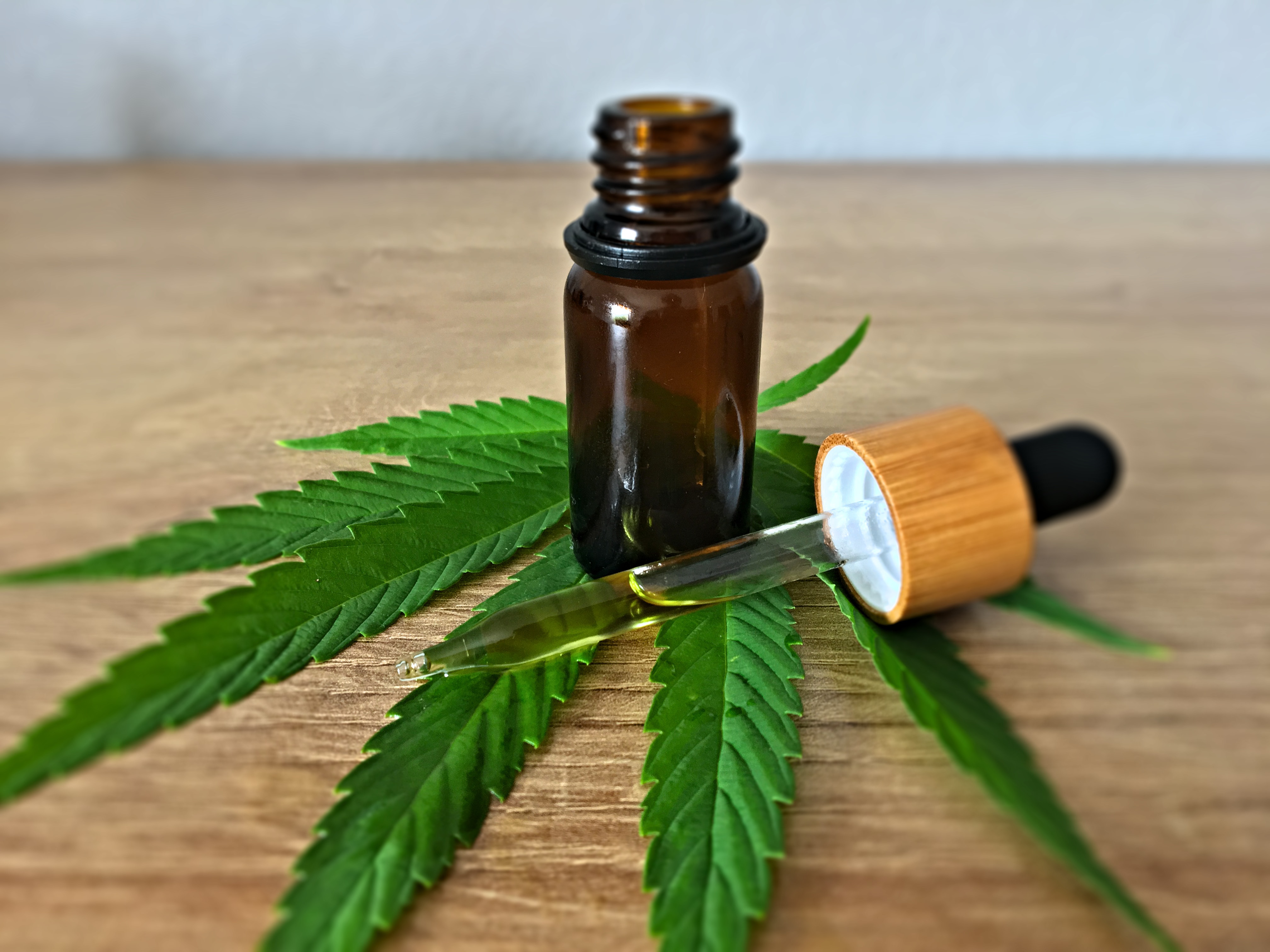
CBD oil and marijuana leaf. Image by Julia Teichmann from Pixabay.
The amount of sleep we get at night impacts the operation and production we present the next day – at school, at work, or simply running errands, so it goes without saying, sleep is important.
Millions of Americans suffer from long-term sleep disorders according to the National Institute of Neurological Disorders and Stroke. Many have turned into taking prescription sleeping pills to help them sleep. However, these pills can be addictive and habit forming.
For numerous people who do not want to dabble with prescription drugs, looking for alternative natural options is the way to go and this is where cannabidiol (CBD) comes into play.
CBD is a reasonable alternative to prescription pills. Not only can it help with sleep, but it also impacts the sleep sequence. CBD reduces REM during sleep – this is the stage in sleep when insomnia can occur. Cannabidiol blocks anxiety states produced in the REM sleep phase, which helps someone suffering from sleep disorder have a longer sleeping time.
If you’re thinking about trying CBD oil to battle your insomnia, it is recommended that you find one that is 100% CBD oil. Trying one that is not pure may have a more inadequate outcome. The suggested dosage to help with sleep is between 40-160 milligrams of CBD taken orally. The specific measure taken depends on the person’s body weight as well as the concentration of CBD per milliliter of oil.
Pesto pasta made with canna oil. Photo by Eaters Collective on Unsplash.
You can cook or bake just about anything with marijuana – brownies, pasta, omelets, french toasts, soups, salads, sandwiches – whatever the dish, it’s possible. The essential to cooking or baking with weed is mastering how to create it with canna oil or cannabutter.
However, before you do anything, you must decarboxylate the cannabis first. The most common beginners’ mistake is to grind up some weed and mix them in with the recipe. That does not work! The cannabis needs to have its composites activated through heat. This is called decarboxylation. Think about when you’re smoking pot, you have to light it with fire, thus activating the compounds of the weed.
To decarboxylate cannabis you’re going to need to place it on a baking sheet and pop it in the oven for 25 minutes to an hour, depending on the quantity, at 225 – 240 degrees. There are resources and videos online you can read and watch to do this right. Here’s a video from Leafly showing 3 different ways you can decarboxylate at home.
Once you’ve decarboxylated your cannabis, it is now ready for use to create cannabutter or canna oil – the main THC and CBD source for your edible recipes. Again, you can find many resources and videos online on how to make cannabutter or canna oil – simply do a Google search. They are simple to use and can be done on a stovetop or even a slow cooker, like a Crock-Pot – pun intended.
When the cannabutter or canna oil is ready, you can now create whatever yummy edible dish or sweets you want. Bon appetit!
Premium CBD hemp extract. Photo by Enecta Srl on Unsplash.
A survey led by OnePoll for HempFusion shows 8 out of 10 Americans have made a complete 180 in their opinions regarding cannabis and marijuana consumption.
Based on the answers of participants who had changed their mind in some form, 46 percent strongly agreed and 36 percent somewhat agreed that it was because of the growth in CBD goods.
When questioned if they believed they had shifted more open to CBD use after getting over doubt from early drug awareness and anti-cannabis messaging when younger, 47 percent of the participants who changed their minds were in strong agreement. Legislative reforms have also had a huge influence. 36 percent of participants said they have tried a CBD product within the past year alone.
The complete 180 trends appeared in a more comprehensive study measuring Americans’ openness to trying new things across the food, wellness and health sectors.
Top five things Americans are willing to try: 1 Food: 68 percent 2. Drinks: 67 percent 3. Health and wellness products: 65 percent 4. Natural pain remedies: 54 percent 5. Visiting or traveling to new places: 53 percent
Top five influencers to try new products: 1. A friend’s introduction to the product: 54 percent 2. Advertisement on social media: 54 percent 3. Advertisement on TV: 51 percent 4. A family member’s introduction to the product: 51 percent 5. A trusted store begins to carry a product: 48 percent
Colorado Harvest cannabis dispensary. Photo by Alex Person on Unsplash.
Flowhub, a cannabis retail management platform company, is seeing to face the need for tools to manage the particulars of the weed retail business. As cannabis dispensaries grow throughout the nation, the demand for such software surges.
According to CFO Kyle Sherman, Flowhub’s platform of dispensary services not only acknowledge compliance matters, but it also combines with companies for online ordering to expedite in-store purchases and adds integrations with LeafBuyer and Leafly to provide more data to potential retailers.
The company also updated its software and added the “Stash” app, a mobile inventory management system, and a cashier app that accommodates tablets like iPad or Samsung Galaxy Tab to improve point-of-sale capacities.
As more states make cannabis legal ending prohibition, Sherman said, “Every legal transaction completed with the Flowhub retail platform is a positive step forward, and we are committed to helping our customers build thriving cannabis businesses. With this investment, we will continue to automate the cannabis supply chain, retail and reporting processes and bring to market technology solutions that are not only shaping the cannabis retail business, but also driving forward the future of legalization and de-stigmatization.”
Green kush farm. Photo by Robert Baker on Unsplash.
Thailand will be hosting the first World Ganja Festival in 2020. But hold on before you book your flight and hotel – it’s not a party kind of festival.
The festival will advocate Thailand as the developer of top strains. It will deliver as a program for people to share their knowledge of marijuana for medical purposes. Um, so, it sounds more like a conference.
According to honorary adviser to the festival, General Charan Kullawanit, they are deciding who to invite from China, Japan, and the United States as guests to give presentations and ideas.
With more people globally accepting marijuana as a practical form of medical use, Thailand is aiming to cash in on this to spur its economic growth. It is serious about getting into the cannabis business. In 2018, Thailand legalized marijuana plants for medical use becoming the first country in Southeast Asia to do so.
Man blowing vape cloud. Photo by Quinten de Graaf on Unsplash.
CT Pharmaceutical Solutions, a Connecticut medical marijuana company demonstrated its method of producing marijuana into vape cartridges.
Kim Provera, a CTPharma rep showed Susan Raff – a local Connecticut TV reporter, the process of how marijuana goes from bud to vape.
Provera explained, “Once we have a concentrated form, its pure form, we put it into cartridges. We use a filling machine to make sure each one is filled to the same level.”
And since Connecticut law requires third party testing for all medical marijuana, samples are shipped to Altasci Labs in New Britain for testing.
Joe Zavaleta at Altasci Labs said medical marijuana is held to strict standards. “If people go to the black market, they are really rolling the dice because they don’t know where it was produced and definitely no quality control standards.” Watch the video below.
Most of the problem with the current vaping crisis has been linked to e-cigarettes, but it has affected the sale of marijuana vapes due to the fear. I think it would benefit cannabis vape producers to be transparent on how they go about making their vape product to ease the mind of their consumers.





 Yes! Cannabis!